
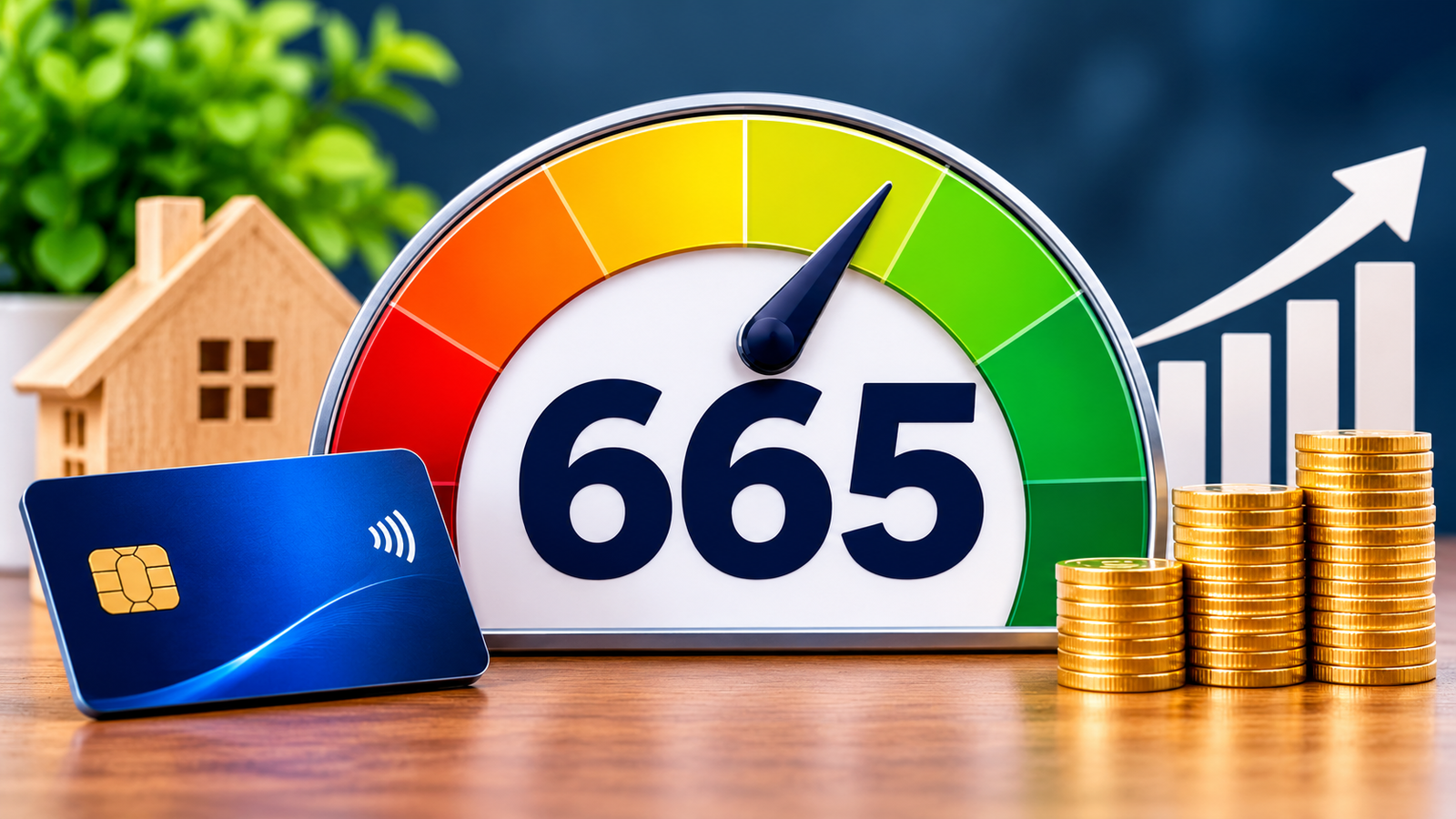
A credit score plays an important role in your financial life, especially when you want to apply for a credit card, purchase a car, qualify for a mortgage, or borrow money through a personal loan. Lenders use credit scores to evaluate how responsibly you have managed credit in the past and estimate the risk of lending to you. If your current score is 665, you may be wondering whether it is good enough to qualify for financial products and competitive interest rates.
A 665 credit score is considered fair under the standard FICO scoring model. It is close to the good credit category, which begins at 670, but it has not quite reached that level. This means you may qualify for certain credit cards and loans, although some lenders may charge higher interest rates or apply stricter approval requirements.
The positive news is that 665 is only five points below the FICO good credit range. By managing your payments, reducing credit card balances, and reviewing your credit reports, you can work toward a stronger credit profile. Understanding what this score means and how lenders evaluate it can help you make better borrowing decisions.
Is a 665 Credit Score Good?
A 665 credit score is considered fair under FICO. Although it is not classified as good, it is within a range where many lenders may still consider applications for credit cards, auto loans, personal loans, and certain mortgage products.
FICO scores generally range from 300 to 850. A higher score usually indicates lower credit risk, while a lower score may suggest that a borrower has experienced payment difficulties, high debt levels, or other credit-related challenges.
Understanding FICO credit score ranges
Here are the commonly used FICO credit score categories:
| FICO Credit Score | Rating |
| 300–579 | Poor |
| 580–669 | Fair |
| 670–739 | Good |
| 740–799 | Very Good |
| 800–850 | Exceptional |
With a score of 665, you are near the top of the fair category. Reaching 670 would move you into the good range.
What does 665 mean under VantageScore?
VantageScore 3.0 and 4.0 use a different classification system, even though their scores generally range from 300 to 850.
| VantageScore Range | Rating |
| 300–499 | Very Poor |
| 500–600 | Poor |
| 601–660 | Fair |
| 661–780 | Good or Prime |
| 781–850 | Excellent or Superprime |
This means a 665 score is classified as good under VantageScore but fair under FICO. The difference is important because lenders may use different scoring models when reviewing applications.
How Does a 665 Credit Score Compare With the National Average?
A 665 FICO score is below the average credit score in the United States. FICO reported an average U.S. credit score of 714 in its Fall 2026 Credit Insights report. This places a 665 score 49 points below the national average.
However, being below average does not mean you cannot access credit. Many lenders consider applicants with fair credit, although the available products and borrowing costs may be less attractive than those offered to people with very good or exceptional credit.
Why the national average matters
The national average gives you a general idea of where your score stands compared with other consumers. It is not an approval requirement.
For example, a lender may approve someone with a 665 score because they have stable income, manageable debt, and a reasonable payment history. Another lender may reject an applicant with a higher score because of excessive debt or other financial concerns.
Your credit score is one part of your overall financial profile, not the only factor lenders evaluate.
Can You Get a Credit Card With a 665 Credit Score?
Yes, it is possible to get a credit card with a 665 credit score. However, your choices may be more limited than those available to consumers with good or very good credit.
Some credit card issuers offer products designed for people with fair credit. These may include basic unsecured cards, secured credit cards, and selected cashback cards.
Credit card options to consider
With a 665 score, you may want to research the following options:
- Secured credit cards: These cards require a refundable security deposit that usually determines your credit limit.
- Fair-credit credit cards: Some issuers consider applicants with scores in the fair range.
- Basic cashback cards: Certain cards offer rewards on everyday purchases without requiring excellent credit.
- Credit-builder cards: These products may help consumers establish or rebuild their credit history.
- Retail credit cards: Some store cards have more flexible approval requirements, although their interest rates may be high.
Before applying, check the issuer’s eligibility guidelines and annual fees. Avoid submitting several applications at once because multiple hard inquiries may temporarily affect your credit score.
How to improve your chances of approval
Review your existing credit card balances and make sure your accounts are current. If you have high utilization, paying down your balances may strengthen your application.
You can also look for prequalification options. These often use a soft inquiry to estimate your approval chances without affecting your traditional credit score, although a formal application may still require a hard inquiry.
Can You Buy a House With a 665 Credit Score?
Yes, buying a house with a 665 credit score may be possible. However, the mortgage programs available to you and the interest rate you receive will depend on your complete financial situation.
Some mortgage lenders accept borrowers with fair credit, but their requirements may vary. Your income, debt-to-income ratio, down payment, employment history, and property details can all influence the decision.
Conventional mortgage loans
Conventional mortgages are offered by private lenders and generally follow guidelines established by Fannie Mae and Freddie Mac.
A 665 score may meet the minimum credit score requirement for certain conventional mortgage programs. However, lenders can apply additional requirements, and a higher score may help you qualify for more favorable pricing.
You should compare offers from multiple lenders to understand which programs are available based on your financial profile.
FHA mortgage loans
FHA loans are backed by the Federal Housing Administration and are designed to make homeownership more accessible to eligible borrowers.
Under standard FHA guidelines:
- Borrowers with a qualifying score of 580 or higher may be eligible for a down payment as low as 3.5%.
- Borrowers with scores between 500 and 579 generally need a down payment of at least 10%.
A 665 score is above the commonly cited FHA minimum thresholds. However, individual lenders may have stricter requirements, and meeting a minimum score does not guarantee approval.
How to strengthen your mortgage application
If you are planning to purchase a home, consider reducing outstanding debt before applying. A lower debt-to-income ratio can make your financial profile more attractive.
You should also avoid opening unnecessary credit accounts before submitting a mortgage application. Maintain on-time payments, save for a suitable down payment, and compare mortgage costs from different lenders.
Is a 665 Credit Score Good for a Car Loan?
A 665 credit score can help you qualify for an auto loan, but you may not receive the lowest interest rates available.
Auto lenders work with borrowers across different credit categories. Some specialize in financing for people with fair or limited credit, while others prefer applicants with stronger credit histories.
One important detail is that auto lenders may use industry-specific scoring models, such as FICO Auto Scores. These scores can differ from the general FICO score displayed by your bank or credit monitoring service.
What auto lenders consider
Your credit score is important, but lenders generally evaluate several other details:
- Monthly income and employment stability
- Existing credit card and loan balances
- Previous auto loan payment history
- Down payment amount
- Vehicle price and age
- Requested loan amount and repayment period
A strong income and manageable debt may help support your application, even if your score is in the fair category.
Ways to get better auto loan terms
Before purchasing a vehicle, consider getting prequalified through a bank or credit union. Comparing multiple offers can help you understand the interest rates and repayment terms available to you.
A larger down payment may reduce the amount you need to borrow. You should also compare the total cost of financing rather than focusing only on the monthly payment.
If possible, work on improving your credit before applying. Moving from 665 to 670 or higher may strengthen your profile, although the impact depends on the lender’s scoring model and requirements.
What Interest Rates Can You Expect With a 665 Credit Score?
There is no fixed interest rate for a 665 credit score. The rate you receive depends on the type of loan, lender, current market conditions, loan amount, repayment period, and your overall financial profile.
Since 665 falls within the fair FICO category, you may receive higher borrowing costs than someone with a score of 740 or 800. Some lenders may also require a larger down payment or additional documentation.
Factors that influence your interest rate
Payment history: A record of paying bills on time can strengthen your application. Recent missed payments may make lenders more cautious.
Credit utilization: Using a large portion of your available credit can negatively affect your credit profile. Lower utilization is generally preferable.
Debt-to-income ratio: Lenders compare your monthly debt payments with your gross monthly income. A lower ratio can improve your borrowing position.
Loan amount: The amount you borrow may influence the lender’s risk assessment and available interest rates.
Repayment period: Longer loan terms can result in higher total interest costs, even if the monthly payment is smaller.
Down payment: A larger down payment on a home or vehicle can reduce the amount financed and may improve your application.
The best approach is to compare multiple lenders and review the annual percentage rate, fees, and total repayment amount before accepting an offer.
What Factors Affect a 665 Credit Score?
Your credit score is calculated using information from your credit reports. FICO considers several major categories to estimate how likely you are to repay borrowed money as agreed.
Understanding these categories can help you identify which financial habits may be holding your score back.
1. Payment history
Payment history accounts for approximately 35% of a typical FICO score. It is the most influential scoring category.
Late payments, missed payments, collections, and serious delinquencies can negatively affect your credit history. Even one late payment may cause a noticeable decrease, depending on your existing credit profile.
Try to pay all credit card and loan bills by their due dates. Automatic payments and calendar reminders can help you avoid missing deadlines.
2. Credit utilization
Amounts owed account for approximately 30% of a typical FICO score. Credit utilization measures how much of your available revolving credit you are using.
For example, if your total credit card limit is $5,000 and your outstanding balance is $2,000, your utilization ratio is 40%.
Reducing your balances can help improve your credit profile. Keeping utilization relatively low is generally a good practice, and you do not need to carry a balance or pay interest to build credit.
3. Length of credit history
The length of your credit history accounts for approximately 15% of a typical FICO score.
Older accounts can help demonstrate a longer record of credit management. Closing an older credit card may affect your available credit and utilization, so consider the possible consequences before closing an account.
4. New credit
New credit accounts for approximately 10% of a typical FICO score. This category considers recent credit applications and newly opened accounts.
Applying for several credit cards or loans within a short period may create multiple hard inquiries. These inquiries can temporarily lower your score.
Apply for new credit only when you need it, and research eligibility requirements before submitting an application.
5. Credit mix
Credit mix accounts for approximately 10% of a typical FICO score. It considers the different types of credit you manage, such as credit cards, mortgages, and installment loans.
Having experience with different types of accounts may contribute positively to your profile. However, taking out an unnecessary loan simply to improve your credit mix is not a good financial decision.
How Can You Improve a 665 Credit Score to 670, 700, or 740?
A 665 credit score is close to the good FICO category. Reaching 670 is a reasonable first milestone, followed by 700 and eventually 740.
There is no guaranteed timeline for achieving these goals. Your progress depends on the information in your credit reports, your existing debt, and the financial habits you maintain.
Pay every bill on time
Make all credit card, auto loan, mortgage, and other reported credit payments by their due dates. Payment history is a major part of your FICO score, so avoiding late payments is essential.
If you have missed payments, bring overdue accounts current as soon as possible. Contact your lender if you are experiencing financial difficulties and ask whether payment arrangements are available.
Reduce credit card balances
High credit utilization may be one reason your score is not higher. Paying down revolving balances can reduce utilization and may support score improvement.
For example, if your total credit limit is $10,000 and you owe $4,000, your utilization is 40%. Reducing the balance to $2,000 would bring utilization down to 20%.
Avoid unnecessary credit applications
Each new application may result in a hard inquiry. Multiple applications within a short period can make your credit profile appear riskier to some lenders.
Compare available products and use prequalification tools where possible before submitting formal applications.
Keep older accounts open when appropriate
Older accounts may help maintain the length of your credit history and available credit. If an account has no annual fee and remains useful, keeping it open may be beneficial.
However, consider account fees, security, and your personal financial needs before making a decision.
Check your credit reports for errors
Review your credit reports from Experian, Equifax, and TransUnion. Look for unfamiliar accounts, incorrect balances, inaccurate payment records, or other information that does not belong to you.
You can obtain free credit reports through AnnualCreditReport.com. If you discover inaccurate information, dispute it with the relevant credit bureau and the company that supplied the information.
Be patient with the improvement process
Credit scores do not always increase immediately after you make a payment or correct an account. Creditors generally need to report updated information before scoring models can reflect the changes.
Avoid companies that promise instant score increases or guaranteed removal of accurate negative information. Consistent credit management is a more reliable approach.
Is It Worth Increasing a 665 Credit Score to 700 or 740?
Yes, improving a 665 FICO score can be worthwhile, especially if you plan to apply for a major loan.
Reaching 670 moves you into the good FICO category. A score of 700 provides a stronger position within that category, while 740 marks the beginning of the very good range.
Benefits of reaching 670
Moving from 665 to 670 crosses an important FICO category boundary. Some lenders may view your application more favorably, although approval and interest rates still depend on other factors.
Benefits of reaching 700
A 700 score gives you more room within the good category. It may improve your eligibility for certain credit cards and loans compared with a lower fair score.
Benefits of reaching 740
A 740 FICO score enters the very good category. Some lenders may offer more competitive interest rates and terms to borrowers in this range.
However, there is no universal cutoff that guarantees a particular rate. Different lenders use different scoring models and underwriting standards.
Conclusion
A 665 credit score is considered fair under the standard FICO model, but it is close to the good credit category that begins at 670. You may qualify for certain credit cards, auto loans, and mortgage products, although your borrowing costs could be higher than those offered to consumers with stronger credit. Under VantageScore, the same number falls within the good or prime category, showing why it is important to know which scoring model you are checking. Focus on paying bills on time, reducing credit card balances, limiting unnecessary applications, and reviewing your credit reports. With consistent financial habits, you can work toward 670, 700, and eventually 740.
Frequently Asked Questions
1. Is a 665 credit score good or bad?
A 665 credit score is fair under FICO. It is close to the good category, which starts at 670. Under VantageScore 3.0 and 4.0, 665 is classified as good or prime.
2. Can I buy a house with a 665 credit score?
Yes, it may be possible to qualify for a mortgage with a 665 score. Certain conventional and FHA loan programs may accept applicants in this range, depending on their income, debt, down payment, and lender requirements.
3. Can I get a car loan with a 665 credit score?
Yes. Some auto lenders approve borrowers with fair credit. However, your interest rate and loan terms will depend on your credit history, income, down payment, vehicle price, and the scoring model used.
4. How many points do I need to reach good credit from 665?
You need five additional points to reach 670, which is the beginning of the good FICO credit category. Your score may change as updated account information is reported, but there is no guaranteed improvement timeline.
5. How long does it take to improve a 665 credit score?
The time required depends on the reasons behind your current score. Reducing credit card balances may help when updated information reaches the credit bureaus, while recovering from late payments or other serious negative information can take considerably longer.