
Open any investing group chat in the week before an issue and you’ll see the same pattern. Someone posts the IPO GMP, someone else writes “listing gain confirmed,” and the application goes in. Ask what the company actually sells, and the chat goes quiet.
Interest in new issues is high. Indian companies raised a record ₹40,355 crore through 32 mainboard IPOs in September 2026, according to SEBI. With that many issues, primary market investments pull in plenty of first-timers, and grey market numbers travel much faster than prospectuses do.
[Author: add two or three lines of your own here, such as an IPO you applied to because of the GMP, or a listing that went the other way. Delete this note before publishing.]
So here’s what IPO Grey Market Premium means, how to use it sensibly, and where it misleads.
What is IPO Grey Market Premium (GMP)?
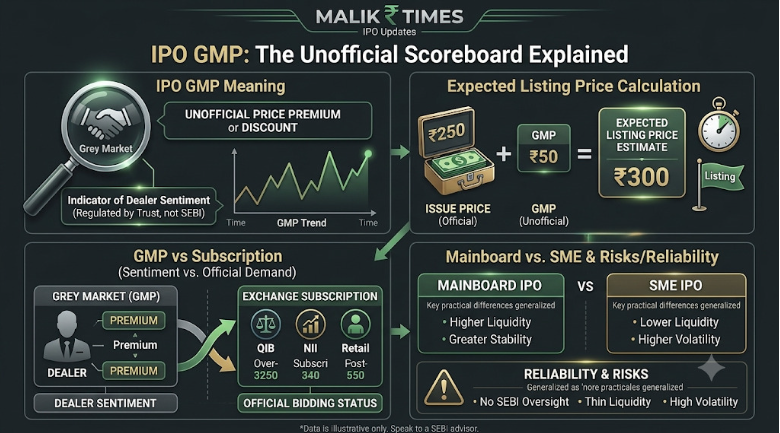
IPO GMP meaning, in one line: it’s the unofficial price gap between an IPO’s issue price and what its shares trade for in the grey market before they list. A positive premium suggests traders expect a listing above the issue price. A negative one, called a discount, suggests the opposite.
The grey market in IPO dealings is an informal network of dealers and brokers. There’s no exchange, no clearing house and no official record, and it isn’t regulated by SEBI. Deals run on trust between parties. That’s why I’d treat it as a source of information about IPO market sentiment and not as a place for ordinary investors to trade.
Don’t confuse GMP with the issue price. The issue price is fixed within the IPO price band by the company and its bankers. GMP is simply what some traders guess the shares will fetch on day one. Investors watch it because it’s a quick read on how demand feels, even though it says nothing about whether the company deserves your money.
How does IPO GMP work?
How IPO GMP works comes down to informal demand and supply. If many traders want shares of a particular IPO before listing and few are willing to sell, the premium rises. If enthusiasm fades, it falls. Nothing official anchors the number, so it can move within hours.
Two terms come up in grey market trading. The Kostak rate is a fixed amount a dealer pays an applicant for the IPO application itself, whether or not allotment happens. Subject to Sauda is a deal where the premium is payable only if the applicant is allotted shares. You’ll see both quoted on tracking sites, but you don’t need to deal in either to use GMP as a signal.
During an issue, the premium usually responds to a handful of things: news about the company, how other IPOs listed recently, the mood in the stock market, and how subscription is going. A strong first day of bidding can lift it. A bad market day can crush it. That swinging is exactly why a single number on Monday means little by Friday.
How to calculate IPO GMP and expected listing price
The maths is simple. Expected IPO listing price equals the issue price plus the GMP. The percentage is GMP divided by the issue price.
Here’s a hypothetical example. An IPO has an upper price band of ₹250 and a latest IPO GMP of ₹50. The expected listing price is ₹300, or 20% above the issue price. If one lot is 60 shares, the lot costs ₹15,000, and the notional gain is ₹3,000.
Now suppose the premium fades to ₹15 by listing day. The estimated price drops to ₹265, a 6% gain, or ₹900 per lot, and that’s before brokerage and taxes. If it turned negative, you’d be looking at a loss.
That’s the catch. Calculated listing prices are estimates built on an unofficial number. Real IPO listing gains depend on what happens on the exchange on listing day, not what dealers guessed a week earlier.
Factors that influence IPO grey market premium
Company fundamentals matter. A profitable business with healthy margins and low debt tends to attract steadier interest than a loss-making one. IPO valuation matters too. A company priced aggressively against listed peers can see its premium shrink as people do the arithmetic.
Subscription demand shapes sentiment. Heavy early bidding lifts premiums, and weak bidding drags them down. Industry outlook adds colour, since a fashionable sector can lift all its issues together. The wider stock market counts as well. IPOs in a rising market often see higher premiums, and the same issue in a falling one may see none.
Finally, retail investor participation pushes numbers around. When lots of small investors pile in, premiums can overshoot. That can look like confirmation, though it’s often just crowd behaviour.
IPO GMP vs IPO subscription status
These two get mixed up, and they shouldn’t be. IPO subscription status is published by the exchanges during the issue and shows how many times the shares offered have been bid for, broken down by category.
Qualified institutional buyers (QIBs) are large funds that do their own research. Non-institutional investors (NIIs) are wealthy individuals and companies. Retail investors bid up to ₹2 lakh. Strong QIB demand is generally a more telling sign than a heavily oversubscribed retail category, because institutions have studied the numbers.
GMP, in contrast, is unofficial and set by a small group of dealers. The two can disagree. You can have a high premium with institutions sitting on their hands, or heavy subscription and a modest premium. When they point in different directions, that’s a prompt for more research, not a reason to pick the one you like. Neither replaces your own analysis.
Mainboard IPO GMP vs SME IPO GMP
A mainboard IPO lists on the NSE or BSE main platforms and is usually a larger, older business that meets stricter eligibility rules. An SME IPO lists on a smaller platform such as NSE Emerge or BSE SME.
On the GMP side, the differences are practical. Mainboard issues are bigger, so more people take part and premiums are somewhat more stable. SME issues are smaller, with thinner trading, so premiums can look dramatic and then collapse. SME lot sizes are often large enough that the minimum application runs to ₹1 lakh or more, so a wrong guess costs more. Liquidity is also thinner after listing, which can make selling at a fair price hard.
Check the minimum amounts and lot sizes for any issue you’re considering, since they vary.
How reliable is IPO GMP for predicting listing gains?
Not very. The honest answer is that GMP is an unofficial indicator, and its record at forecasting actual listing prices is patchy. Sometimes it’s close. Sometimes the shares list far above or below what the grey market suggested, and sometimes the premium collapses just before listing.
The limits are built in. A small group of dealers can move the number. Trading is thin. Rumours spread quickly. And a high GMP doesn’t guarantee positive returns, because what happens after listing depends on valuation, results and the market. Plenty of IPOs with strong premiums have listed flat or traded below issue price within weeks.
So if the only argument for an IPO is “the GMP is high,” you haven’t got an argument yet. Do proper IPO risk assessment first.
How investors can research an IPO before applying
Good IPO investment analysis follows a few steps, none of which involve the grey market.
Read the Draft Red Herring Prospectus (DRHP) and the Red Herring Prospectus (RHP), which carries the final price band. You don’t need every page. Focus on the risk factors, the “objects of the issue,” and the financial statements. Check whether the issue is a fresh issue, where the company keeps the money, or an offer for sale, where existing shareholders cash out.
Look at IPO fundamentals: three years of revenue, profit, debt and operating cash flow. Compare the price-to-earnings ratio at the top of the band with listed peers, and ask whether any premium is justified. Find out who the promoters are, how much they’ll hold after listing, and whether any shares are pledged. Think about the industry’s prospects and risks too.
Then, and only then, glance at GMP as one supporting indicator, next to subscription data and market conditions.
Where to follow IPO GMP and market updates
Reliable information matters here because numbers vary between websites and get stale quickly. Compare more than one source, check the time of any quote, and confirm dates and price bands against the exchange notice or the RHP.
Investors who want to follow grey market movements and expected listing prices can look at Malik Times IPO GMP, which carries IPO grey market premium information alongside other IPO details. Malik Times also publishes broader Malik Times IPO updates. Reading these next to company fundamentals can help you build a more informed picture of the primary market.
Conclusion
IPO GMP gives you a rough read of unofficial IPO market sentiment, and that’s all. It’s useful in the way a crowd’s noise is useful: it tells you how excited people are, not whether they’re right. Research the company, check the price against its peers, decide how much loss you could live with, and treat the premium as a footnote.
Frequently asked questions
What is IPO GMP?
It’s the unofficial premium or discount at which IPO shares trade in the grey market before listing, compared with the issue price.
How do you calculate the expected listing price?
Add the GMP to the issue price. For example, an issue price of ₹250 and a GMP of ₹50 suggests about ₹300. It’s an estimate, not a guarantee.
Is IPO GMP reliable?
Not fully. It’s unofficial, can change quickly and sometimes differs sharply from the actual listing price.
What is the difference between GMP and subscription status?
GMP is an informal dealer-set premium. Subscription status is official data from the exchanges showing demand by investor category.
This article is for general information and isn’t investment advice. Grey market dealings are unregulated, and IPO investing carries risk. Consider speaking to a SEBI-registered advisor before investing.